
What qualifications will they take?
GCSEs have changed
In Key Stage 4, most young people will study for GCSE qualifications. GCSEs are mainly assessed by exams in the summer at the end of the course.
GCSE subjects now have new syllabuses and a new grading system of 9 to 1 with 9 being the highest grade and 1 the lowest. A grade 5 is considered to be a 'good pass'.
The new grading system compares with the previous one as follows:
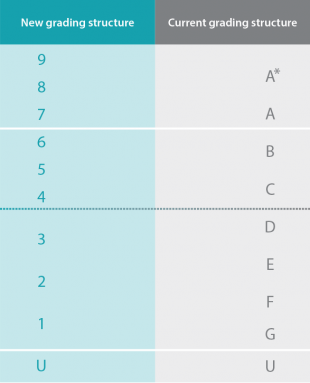
The bottom of a grade 7 is comparable to the bottom of the old grade A, the bottom of a new grade 4 is comparable to the bottom of old grade C, and the bottom of the new grade 1 is comparable to the bottom of the old grade G.
For your son/daughter all their GCSEs will be graded from 9 to 1.
You can read more about the changes to GCSEs on the Ofqual blog
Vocational (work-related) qualifications
Some schools offer courses in subjects such as business, IT, health & social care or engineering amongst their GCSE choices. These qualifications develop their knowledge about particular industries such as hospitality or tourism. They are also known as technical qualifications.
Personalised programmes
Some young people may not be ready to study GCSEs and may need more time to develop their skills, build confidence and gain qualifications that help prepare them for their next step at 16. They may be offered alternative qualifications.
These programmes combine learning in vocational subjects such as catering, hairdressing, construction, childcare or animal care with qualifications in the core subjects of English, maths and IT, and personal development activities such as team building, job search skills and decision-making.
These programmes help young people to progress at their own pace and to build up knowledge and skills at Entry Level, Level 1 or 2 over a period of time.
Points to consider when choosing subjects
- Which subjects are they good at?
- Which subjects do they enjoy?
- How is the subject taught?
- Does it include writing essays?
- Does it involve using research or statistics?
- Do they have a future career in mind?
- The core subjects of English, maths and science are important for most careers they may consider in the future
- Do not choose a subject just because they like the teacher or their friends have chosen it
- Choose subjects they will enjoy - this will help motivate them to learn
- Think about their longer term career or higher education goals, and start to research entry requirements and training that may be involved. It's worth checking entry requirements carefully as some careers and some courses will specify certain qualifications and may ask for specific grades.