
Events
Cambridge Academy for Science and Technology Sixth Form Open Evening
October 21, 2026
5-7.30pm

Level 3 Certificate in Mathematical Studies (Core Maths)
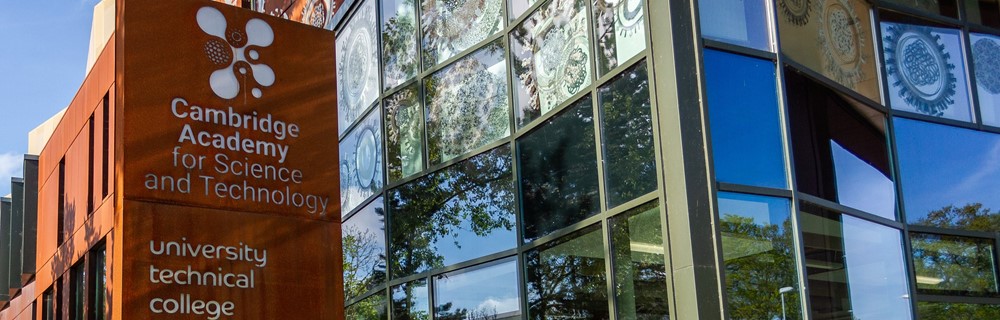
Cambridge Academy for Science and Technology
Robinson Way, Cambridge, Cambridgeshire, CB2 0SZ
GCE A/AS Level or Equivalent
Level 3
Available start dates
Available start dates
Tuesday, 01 September 2026
Cambridge Academy for Science and Technology
2 Year(s)
Full time
Daytime/working hours
-
Course Summary
A level Maths isn’t for you, but you’re planning to study courses that have some mathematical content to them? Then Core Maths is a great option to consider!
In a recent survey of maths that people wished they’d learnt at school, more than 5 of the items appear in the Core Maths syllabus. The course contains elements of:
- Personal finance: the maths of income tax and national insurance and student loans; and how to make decisions regarding mortgages; insurance; credit cards and borrowing
- Estimation: so amongst other things, you’ll also be able to make predictions e.g additional nurse hours required to deliver NHS flu jabs, or cost of building an extension.
- Use and abuse of statistics: will support your work in your other subjects, but will also teach you to be critical of statistics thrown at you every day in the media
Since the content is all set in real world contexts, students who complete the course are surprised by just how much they enjoy it!
Course Details
In the first term of the Core Maths course students use real life contexts to solve problems, highlighting consolidation work that may be required from higher level GCSE content. This is then addressed by the student on an individual basis during the skills sessions, in the same week.
Aspects returned to in a variety of contexts before the first Christmas include: conversion of units of measurement; ratios and percentages - loans and saving; use of spreadsheets; statistical calculations and data distribution comparisons.
In the second term students consider more elements of personal finance, such as how to calculate income tax, National Insurance and student loan payments due. This again requires students to consider their level of understanding of percentages and use of spreadsheets.
Integrated within this work, are strands of problem solving taught as longer projects, such as Singapore Airlines flight timetable, and pilot timetables are built to increasing levels of complexity.
Another common element each week is some form of estimation problem. This builds the student’s confidence in making order of magnitude predictions for what initially sound like impossible problems to solve.
The final term of the first year would be consolidating on the content covered, and continuing to utilize this in a variety of real contexts.
The second year of study makes use of much of the material and basic capabilities acquired in year 1, but now with higher technical level topics.
There are 3 choices of paper, and the group will normally compete the syllabus material for two of the papers, before making a final choice of which single paper 2 they each wish to be entered for.
The end of the summer term, and whole of the Autumn term in Year 2, is spent covering the optional paper 2 content.
- Advanced statistical analysis: the Normal Distribution, correlation and regression, or
- Critical Path Analysis, conditional probability, Risk Estimation, Cost benefit analysis, or
- Graphical analysis and modelling such as rates of change, speed and acceleration; and exponential functions, exponential growth and decay
From the start of the spring term of year 2 the group utilize and consolidate all material covered, by means of extended projects.
As an example, the first spring half term is spent on an open ended group project. In which each group decides on a company to start up: researches business aspects of such a company and prepares a business plan which they present to the ‘bank’ (the class) for set up finance. Subsequent activities would employ year 2 material: i.e. Critical Path Analysis to project plan the build and set up of premises, or statistical analysis of products to be used or sold.
How will it be delivered and assessed?
There are regular assessments and feedback throughout the course, to monitor progress. Then the final external exams are:
Paper 1 1.5 hours all compulsory content studied in year 12
Paper 2 1.5 hours based on critical analysis of real world case studies, plus optional modules chosen
Entry requirements
Students need a minimum of a grade 4 in Maths GCSE.
Core Maths can be combined with either A level or T Level courses.
This course is essential for students that are not studying A level Maths.
Your next steps...
Students graduating from Cambridge Academy for Science and Technology will be exceptionally well prepared to progress into higher education, work or an apprenticeship, ready to build careers that contribute to the Cambridge success story.
University
Graduating from Cambridge Academy for Science and Technology will give you a head start when it comes to choosing a university. Employers are seeking specialist science staff in all areas, and a degree will help take your career to the next level.
Apprenticeships
Our employer partners are highly supportive of apprenticeships, and offer opportunities to our students. Apprentices are paid while they train, attending college one day a week and learning hands-on in the workplace as they gain valuable qualifications. They also offer an alternative route to higher education.
Employment
The Cambridge area is full of highly successful employers ready to take on new staff who leave Cambridge Academy for Science and Technology with an impressive range of specialist qualifications – ready to go straight into the workplace and develop their careers.
Additional information
For more courses like this, check our courses page.